
.png)
Northeast Michigan Great Lakes Stewardship Initiative
Alpena Public Schools
All Saints Catholic School
Marine Debris and the 3Rs
All Saints 7th and 8th graders are developing a culture of conservation in their school. Centered around consumption of plastic and its potential impact on our Great Lakes as marine debris, these students studied single-use plastics in the cafeteria and challenged fellow students to reduce their use of single-use plastics after giving a school-wide presentation about the impact of marine debris. Using curriculum developed by the film Bag It: Is your life too plastic (AVAILABLE THROUGH THE NEMIGLSI LENDING NETWORK), they collected data in their cafeteria and tracked how much they were able to reduce. They also educated cafeteria workers (to remove plastic silverware and return to metal silverware) and school administration. Carrying this message back to the public, the students shared their efforts at a Plastic Pollution Panel and informational table at the 2016 Thunder Bay International Film Festival. These students led a NOAA Students for Zero Waste Week challenge and completed the NEMI Earth Day Bag Project with younger students. They also completed litter cleanups to prevent marine debris from entering the Great Lakes. Continuing their project a second year, the students made ornaments out of trash collected by area students to raise awareness about the impacts of marine debris and how to better protect our Great Lakes now for the Besser Museum for Northeast Michigan's Season of Lights Exhibit!
Archaeology Lesson on a Lake Huron Beach
Sometimes the best way to learn is by jumping right in. And these All Saints students did just that when Stephanie Gandulla, an archaeologist at Thunder Bay Marine Sanctuary, created a mock shipwreck site for them to map and study. Students learned the steps that go into an archaeological site as well as the unique ways shipwrecks are well-preserved in the Great Lakes because of the fresh, cold water. We posted a video with a lot of action shots on our Instagram page after this field visit. You can watch the video by clicking on this link: https://www.instagram.com/reel/CkjkJWqD57f/?utm_source=ig_web_copy_link During this place-based education visit to North Point Preserve on Lake Huron the students also searched for marine debris/micro plastics and learned about the native coastal plant communities.

Great Lakes Fisheries in the Classroom Efforts
From the fall to spring semesters, students raise, care, and maintain Chinook Salmon* in the classroom. They receive the salmon as eggs from MI DNR, and throughout the school year, they see the fish grow from egg, to hatchling, to smolt. Through this project, they learn about life cycles and habitat needs, and in the spring semester, the fish are released into local watersheds allowing these students to improve fish populations. *While the Chinook Salmon is not native to this area, they were introduced and subsequently naturalized to reduce invasive Alewife fish populations. They are also included in the Joint Strategic Plan for Management of Great Lakes Fisheries. Additionally, this fish serves as a biological indicator for the health of our rivers serving as spawning sites. Salmon in the Classroom Involved Schools: Alcona Elementary School, Besser Elementary School, Onaway High School, Oscoda High School, Rogers City Middle School, All Saints Catholic School Involved Community Partners: MI Department of Natural Resources
Northeast Michigan Earth Day Bag Project
In addition to Alpena Public Schools, All Saints 6th, 7th and 8th graders informed their school how plastic impacts our Great Lakes, and following this lesson, 4th and 5th graders decorated these bags to raise awareness about the dangers of plastic bags for our Great Lakes. The Boys and Girls club of Alpena also visited the Thunder Bay National Marine Sanctuary and participated in the lesson and decorating paper bags.
Alpena High School
Shipwreck Ally
This project will provide students an opportunity to make a worthwhile contribution to the Thunder Bay National Marine Sanctuary. They will not only learn many of the same methods employed by sanctuary archaeologists and historians, but they will apply this learning to produce an exhibit that will be displayed and shared with the public. Students will be able to work with these professionals and explore science and history outside the classroom and beyond the textbook.
Great Lakes Maritime Heritage Trail Stories
Community Connections: Northern Lake Huron communities and Great Lakes fishing have always been inextricably intertwined. Yet, the very people and stories that shape this local fisheries history and heritage can just as easily be lost to time – especially when the knowledge, experiences, or pivotal events are found only in an image in a family photo album, a newspaper clipping filed long ago, a book on the back shelf in a library, or an event remembered only in a fisherman’s or woman’s memory. Through research and interviews, Alpena High School students are uncovering local knowledge about how Lake Huron fisheries have shaped their community. This innovative place-based education class engages Alpena students – through their science and language learning – in Great Lakes-focused projects in (and with) their local community. This project has resulted in amazing learning experiences, along with many valued community benefits for the partners working alongside these students. They learned from visiting experts and community members connected with the Lake Huron fishery, but they also visited science and museum centers like the NOAA Thunder Bay National Marine Sanctuary (including a glass-bottom boat tour on Lake Huron) and the Besser Museum for Northeast Michigan. Power in Partnership: Alpena High School students are bringing to life and sharing some of these pivotal people, places, and experiences through trail stories published on the Great Lakes Fisheries Heritage Trail website. The students have tackled this project as part of their school’s Science in the Sanctuary course, a blended science and language course centered on project-based learning supported by Our Fisheries, Our Future. The school and educator team, these student leaders and their community partners coordinated through the Northeast Michigan Great Lakes Stewardship Initiative (a regional place-based education network) with support from a recent Great Lakes NOAA BWET project supporting students engaged in fisheries studies and stewardship. They also worked collaboratively with Michigan Sea Grant, Michigan State University Extension, Besser Museum for Northeast Michigan, NOAA Thunder Bay National Marine Sanctuary, Alpena Convention and Visitors Bureau, and other local Great Lakes Fisheries Heritage Trail network partners. Meaningful Watershed Educational Experiences: Students explored a variety of prospective leads for their fisheries heritage investigations and reached out into the community to conduct interviews with fisheries stakeholders and local experts. They interviewed charter boat captains, fishing festival organizers and anglers, and other community members (sometimes family members) who fish these local waters. They spoke with several Native American and commercial fishing families that fish in northern Lake Huron - both past and present – learning about their family business operations, vessels and gear, markets where fish are sold, and some of the ecological and economic challenges facing their industry. Others visited with local museums in relation to their fisheries heritage exhibits, as well as local authors who have lived, researched, and written about local Lake Huron fisheries. Several museums have historic fishing vessels on display and vessels also lay on the bottom of Lake Huron as part of the NOAA Thunder Bay National Marine Sanctuary. Some students spoke with a state maritime archaeologist to gather histories on these vessels. Resulting from their research and interviews? A treasure trove of knowledge, informational resources, and some amazing stories. This team of students tackled a variety of leads and developed their stories, many of which are now published online and available through the Great Lakes Fisheries Heritage Trail website. Today these stories are more widely available to you and the public because of the investment and dedicated work toward this Science in the Sanctuary community project. 80 Students are involved in this project. 2 Teachers are involved in this project.
Industrial Arts Students Support Lake Huron Costal Habitat by Preserving Hibernacula in Alpena
Alpena Wildcats are joining the effort to help protect and enhance eco-tourism in Alpena! Woodshop and welding students are partnering with numerous organizations to promote conservation and wildlife habitat restoration by helping to protect two local winter hibernacula for bats at Rockport State Recreation Area. Alpena High School industrial arts teachers Ron Cadarette and John Suszek, building on previous work by Scott Mackenzie and current woodworking teacher Zach Grulke, are enthusiastic about supporting their student’s involvement in helping protect not only the bats using the hibernacula, but the public as well. Welding students designed and built custom steel gate structures to protect the hibernacula. The gates were installed and fabricated to each hibernaculum by industrial arts students in early June, 2013. These gates protect the bats habitat by safely excluding the public from accessing these dangerous tunnels while enabling the bats to come and go freely. Additionally, the gates minimize disturbance to the hibernating bats; which can increase their survival. In June of 2014, welding students returned to place a steel plate over a collapsing portion of the tunnel, which was then covered by the DNR with rocks and gravel to provide insulation. Woodworking students are helping promote conservation and wildlife habitat restoration by designing and building summer bat habitat houses that can be placed at the recreation area. This will provide further habitat for bats in the area and promote habitat conservation. In order to better educate Alpena High School students and the local community on the importance of bats, Michelle Maust from the Organization for Bat Conservation (OBC) gave two live bat presentations in early April. The presentations focused on learning the truth about bats and what we can do to protect these critters. The OBC is a nonprofit dedicated to providing resources to protect bats through live animal programs, community education, collaborative partnerships and more.
Microplastics Research Project in Lake Huron
Intro to Chemistry students at Alpena High School have a unique assignment. Join with community agencies and partners to get onto Thunder Bay, Lake Huron and collect samples of lake water. Then take it back to the class, analyze the collection and send it off to a university professor who is very interested in Great Lakes marine debris (including microplastics). During a research cruise onto Lake Huron, students collected water samples aboard the Glass bottom boat Lady Michigan by deploying a surface trawl, a research net designed to sample plastic pollution. Collecting data specific to local Thunder Bay waters, these samples were taken back to the school chemistry lab where they were analyzed for plastics and other chemicals. While on the water, students conducted some field-based water chemistry analysis and learned about biological pollution – aquatic invasive species – also affecting the health of Lake Huron ecosystems. Prior to these field studies, students researched this issue in class, learning first about marine debris, such as the widely publicized Pacific Ocean garbage patch. The class next localized the issue by exploring current scientific research about plastic pollution in the Great Lakes, including studies about microplastic beads that end up in the environment as a by-product of some personal care products. They studied chemistry of plastics and other polymers, and are currently conducting an in-class scientific investigation where students are discovering that plastic debris does not degrade like other marine debris but rather erodes into small particles. Beyond the beauty of our environment, these plastics also pose potential health concerns in Great Lakes ecosystems. In the lab, students conducted a preliminary assessment of their own local Lake Huron samples, which will be shared and verified with Dr. Mason’s research team. Students sorted their samples under microscopes discovering relatively low amounts but a variety of plastic pollution. They found blue plastic fibers they believed to be from nylon roping or blue plastic tarps, along with some brightly colored red, green, and blue particles they thought possibly from shopping bags and plastic wrapping. The class even found a few perfectly round green and blue plastic particles thought to be microplastic beads from personal care products.


Besser Elementary School
Island Park Stewardship & Salmon in the Classroom
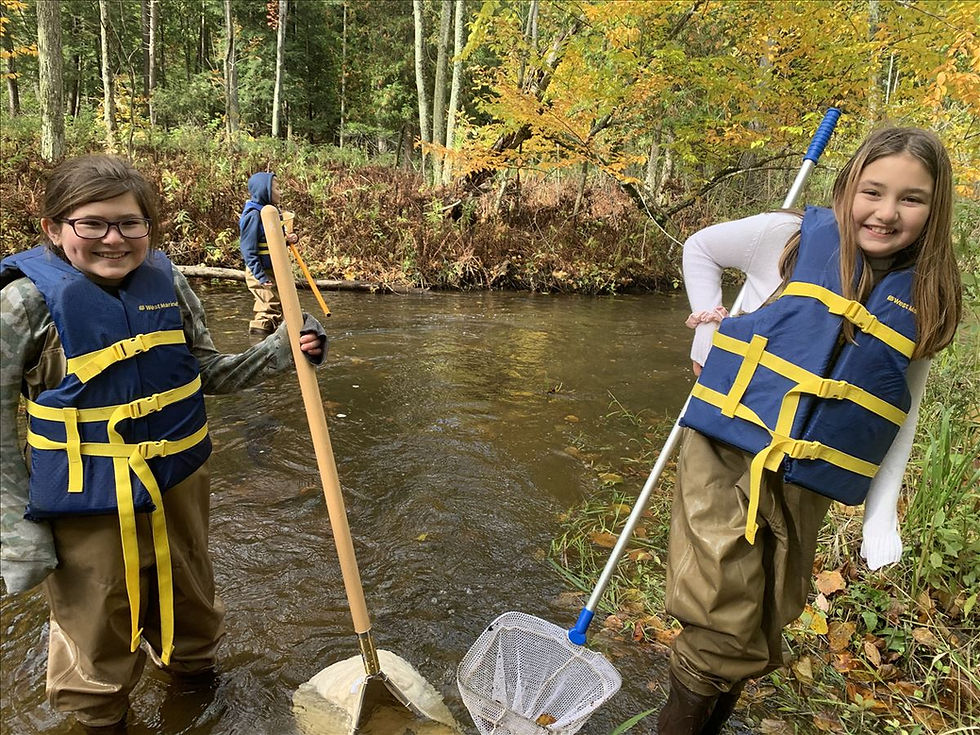
Community Connections: Besser Elementary students raised and released salmon into the Thunder Bay River. Their project represents the broad goal of the Northeast Michigan Great Lakes Stewardship Initiative: to foster community engagement through place-based stewardship education (PBSE). Students were given an opportunity to participate in STEM activities along the shores of Thunder Bay River, which flows through Alpena, MI. Our Fisheries, Our Future has a collective community goal to improve and maintain the well-being of the watersheds around Northeast Michigan. These watersheds provide educational, recreational, and economic benefits to the surrounding communities. These strengthened community ties give students a network of support that will help them grow personally as young professionals, and future community leaders. Experiencing different community concerns, Mrs. Hartmeyer and her students are better able to understand ways to increase the ecological and economic value of Northeast Michigan. Power in Partnership Many partners come together as part of the NEMIGLSI network to support this place-based stewardship education project. Teachers and students alike worked along side environmental STEM professionals from the Michigan Department of Natural Resources, U.S. Fish and Wildlife Services, Michigan State University Extension, 4-H volunteers, Huron Pines AmeriCorps members, and Hammond Bay Biological Station Sea Lamprey research. The Besser Museum served as an educational destination to help students better understand the connection between watershed and wildlife studies. Huron Pines AmeriCorps members assisted with various field activities while the Great Lakes Fishery Commission brought Sea Lamprey to the students to discuss invasive species. The salmon in the classroom project was not the only benefit of being a Our Fisheries, Our Future teacher or student. This project also provided participating teachers with professional development pertaining to fisheries science and watershed ecosystems. Teachers explored new materials and curriculum, and were also able to connect with like-minded educators. Teachers professional learning opportunities enhances educator knowledge which provides an improved experience for students. Meaningful Watershed Education Experiences Mrs. Hartmeyer’s fifth grade classes from Besser Elementary School visited Rotary Island Mill Park to support their community and learn from their environment. Through Our Fisheries Our Future, Ms. Hartmeyer's class participated in the Michigan Department of Natural Resources Salmon in the Classroom program. Their day on Rotary Island was the culmination of months of classroom learning and the release of their salmon. Students engaged in a variety of environmental activities including nature journaling with Huron Pines AmeriCorps, wetlands investigation and salmon data collection with U.S. Fish and Wildlife Services, and invasive species exploration with Great Lakes Fishery Commission Sea Lamprey experts. Students measured and weighed each salmon before the release and used that information to calculate and analyze the overall health of their fish. They also conducted an assessment of fish habitat and water quality of the river. They assessed both the biotic and abiotic qualities of the river through chemical tests and sampling aquatic macroinvertebrate. Students were able to gain real world science experiences by working directly with STEM field professionals. 74 Students are involved in this project. 2 Teachers are involved in this project.
Northeast Michigan Earth Day Bag Project
In honor of Earth Day, Northeast Michigan youth participate in the Northeast Michigan Earth Day Bag Project. This project allows students to learn more and raise awareness about the dangers of single-use plastics, like plastic bags, for our Great Lakes and ocean. This project idea originated from the Earth Day Groceries Project, a world-wide activity coordinated online to develop educational activities on Earth Day. Working in partnership with the Northeast Michigan Great Lakes Stewardship Initiative, its community partners, and local grocery stores, students decorate paper bags to convey messages regarding conservation and preservation following a discussion about the dangers of using plastic bags. These paper bags will then be distributed to customers on Earth Day, April 22nd. The students’ campaign aims to lower the use of plastic bags, which have harmful environmental consequences, and to advocate the use of reusable bags. Single-use plastics, like plastic bags, are especially dangerous since they can enter into the ecosystem and break down into microplastics. Microplastics are small pieces of plastic that can absorb pollutants. Confused as food, they are commonly consumed by fish and birds; this consumption can ultimately lead to the animal’s death. This simple learning project allows students the opportunity to provide a great environmental service as well as the ability to take an active role in making a positive contribution to their community. Support these students in this community effort to keep the Great Lakes plastic-free by using reusable bags and refusing to single use! ALPENA Led by local teachers, 3rd, 4th and 5th graders in Alpena Public Schools learned about the impact of marine debris and connected these messages with their community. Students from Besser Elementary, Hinks Elementary, Lincoln Elementary, Sanborn Elementary, and Wilson Elementary all participated in this project! This year at Ella White Elementary, a 5th grade class led this project with 1st-5th graders throughout the school. Working in partnership with Neiman's Family Market, over 1,000 Alpena students decorated paper grocery bags to educate their community about the impact of plastic pollution and the importance of reducing our use of disposable plastics.


Ella White Elementary School


Great Lakes Fisheries in the Classroom Efforts
As part of the Thunder Bay Reef Restoration Project, Ella White 5th graders raise Lake Trout in the classroom. In the fall semester, they receive Lake Trout eggs. Throughout the school year, these fish grow allowing the students to learn about life cycles, and in the spring, they release Lake Trout fry on the artificial reef in Thunder Bay, Lake Huron. To release the fish on the reef, the students engineered and built ROVs (remotely operated vehicles) in cooperation with Thunder Bay National Marine Sanctuary. They also used a 3-D printer to produce a system (adapting a plastic pop bottle) to release their young lake trout to their underwater reef habitats. Excitingly, in March 2015, this project was selected as winner in the Teach for the Planet Challenge, and as result, these students won $10,000 in DonorsChoose.org credits for their engineered lake trout delivery system project! To learn more about this student-led project, visit the Ella White- Native Fish and Restoration Project page. Involved School: Ella White Elementary School Involved Community Partners: MI DNR, U.S. Fish and Wildlife Service, Thunder Bay National Marine Sanctuary, MI Sea Grant
Northeast Michigan Earth Day Bag Project
In honor of Earth Day, Northeast Michigan youth participate in the Northeast Michigan Earth Day Bag Project. This project allows students to learn more and raise awareness about the dangers of single-use plastics, like plastic bags, for our Great Lakes and ocean. This project idea originated from the Earth Day Groceries Project, a world-wide activity coordinated online to develop educational activities on Earth Day. Working in partnership with the Northeast Michigan Great Lakes Stewardship Initiative, its community partners, and local grocery stores, students decorate paper bags to convey messages regarding conservation and preservation following a discussion about the dangers of using plastic bags. These paper bags will then be distributed to customers on Earth Day, April 22nd. The students’ campaign aims to lower the use of plastic bags, which have harmful environmental consequences, and to advocate the use of reusable bags. Single-use plastics, like plastic bags, are especially dangerous since they can enter into the ecosystem and break down into microplastics. Microplastics are small pieces of plastic that can absorb pollutants. Confused as food, they are commonly consumed by fish and birds; this consumption can ultimately lead to the animal’s death. This simple learning project allows students the opportunity to provide a great environmental service as well as the ability to take an active role in making a positive contribution to their community. Support these students in this community effort to keep the Great Lakes plastic-free by using reusable bags and refusing to single use! ALPENA Led by local teachers, 3rd, 4th and 5th graders in Alpena Public Schools learned about the impact of marine debris and connected these messages with their community. Students from Besser Elementary, Hinks Elementary, Lincoln Elementary, Sanborn Elementary, and Wilson Elementary all participated in this project! This year at Ella White Elementary, a 5th grade class led this project with 1st-5th graders throughout the school. Working in partnership with Neiman's Family Market, over 1,000 Alpena students decorated paper grocery bags to educate their community about the impact of plastic pollution and the importance of reducing our use of disposable plastics.
Thunder Bay Junior High


Great Lakes Fisheries in the Classroom
Across northeast Michigan, students are raising different fish species in the classroom. Through these projects, they connect with area scientists to help with restoration and stocking projects, and they learn about the needs and characteristics of the fish. They also increase community awareness about our fisheries by developing promotional materials about the fish and/or connecting their project with younger grades at their school. This hands-on learning activity allows students to connect to their area watersheds while benefiting their local community and environment. LAKE STURGEON IN THE CLASSROOM At the beginning of the school year, students receive a fingerling Lake Sturgeon from Sturgeon for Tomorrow and MI Department of Natural Resources to care for throughout the year. Students are responsible for maintaining the tank, testing the water quality, and feeding bloodworms to the Lake Sturgeon. Near the end of the school year, the fish is released, and in 2014, the different fish grew from 5 inches up to 18 inches when released. Prior to its release, the sturgeon is chipped with a PIT tag. This tagging allows future students to stay connected to the fish since with each recapture they will be notified with the location and an update of its growth and health. This project is a perfect example of place-based stewardship education since students are learning about their local watershed a threatened fish species while improving local fisheries with the fish’s release. Involved Schools: Cheboygan Elementary School, Thunder Bay Junior High, Onaway High School, Alcona Elementary, Inland Lakes Elementary Involved Community Partners: Sturgeon for Tomorrow, MI DNR, Michigan Sea Grant, U.S. Fish and Wildlife, MSU Department of Fisheries and Wildlife Involved Community Partners: MI DNR, U.S. Fish and Wildlife Service, Thunder Bay National Marine Sanctuary, MI Sea Grant
Invasive Buckthorn Management
The Outdoor Education Site has four main objectives: EDUCATION- This objective reaches beyond student education at the Jr. and Sr. High, inviting the community to join in and learn. Partners like Huron Pines, the US Fish and Wildlife Service, NEMI GLSI, Thunder Bay Tree Service, and A Step Above Tree Service lend expertise to educate those involved. CONSERVATION- The Ed. Site provides a wild space on the edge of city limits, wedged between the Junior High and High School campuses, and is on the brink of total invasion by buckthorn and other species. Management of this woody shrub is priority in the site’s conservation goals. ACCESS- Accessible wild areas, even within northeast Michigan, can be difficult to visit for a variety of reasons. With its proximity to town, neighborhoods and the schools, the trails get frequent use. Trail maintenance is needed to keep the corridor and surface in usable condition. INTERPRETATION- This site will be a platform for community education of invasive species, local ecology, land management, student citizenship, health and fitness and community partnerships. A map of the trail system will be generated, as well as on-site maps to give users direction and current location. Identification of plants, trees, and unique ecosystems will be interpreted on low-profile, natural signs to give the user a total experience and walk away with an understanding of place. Click here to see a recent mapping of Buckthorn management from Great Lakes FieldScope.
Lincoln Elementary School
Lunchroom Waste Turned Eco-Brick Bench
There were lots of cheers when the 5th grade Lincoln Elementary class unveiled an eco -brick bench to the entire school at an assembly! They spent the school year using lunchroom waste to create this bench. They would take a lot of the soft plastic like styrofoam lunch trays and food wrappers, clean it and then stuff it into cleaned 2 liter bottles that were donated by Pepsi. Once the bottles were firm, they could use them as bricks. The whole school was involved since all of the lunchroom materials were sorted into different bins at the end of lunch versus going in the trash can. The 5th graders tracked the amount of trash included in the bench project and the weight totaled up to 1,354 ounces which is almost 85 pounds! That is a lot of trash being kept out of the landfill. If not properly disposed of or recycled, trash like this can make its way into local watersheds, turning into marine debris which have harmful effects on water quality and wildlife. Funding for this project was through a NOAA B-WET grant: "Marine Debris: Prevention Today for Healthy Waters Tomorrow." Maia Proulx is the 5th grade teacher who helped lead this project. The bench will be a new feature at Lincoln Elementary School. The students had a few 'bricks' left over so they made a side table too! This is a link to an Instagram post we did about it: click here to see it.
Northeast Michigan Earth Day Bag Project
In honor of Earth Day, Northeast Michigan youth participate in the Northeast Michigan Earth Day Bag Project. This project allows students to learn more and raise awareness about the dangers of single-use plastics, like plastic bags, for our Great Lakes and ocean. This project idea originated from the Earth Day Groceries Project, a world-wide activity coordinated online to develop educational activities on Earth Day. Working in partnership with the Northeast Michigan Great Lakes Stewardship Initiative, its community partners, and local grocery stores, students decorate paper bags to convey messages regarding conservation and preservation following a discussion about the dangers of using plastic bags. These paper bags will then be distributed to customers on Earth Day, April 22nd. The students’ campaign aims to lower the use of plastic bags, which have harmful environmental consequences, and to advocate the use of reusable bags. Single-use plastics, like plastic bags, are especially dangerous since they can enter into the ecosystem and break down into microplastics. Microplastics are small pieces of plastic that can absorb pollutants. Confused as food, they are commonly consumed by fish and birds; this consumption can ultimately lead to the animal’s death. This simple learning project allows students the opportunity to provide a great environmental service as well as the ability to take an active role in making a positive contribution to their community. Support these students in this community effort to keep the Great Lakes plastic-free by using reusable bags and refusing to single use! ALPENA Led by local teachers, 3rd, 4th and 5th graders in Alpena Public Schools learned about the impact of marine debris and connected these messages with their community. Students from Besser Elementary, Hinks Elementary, Lincoln Elementary, Sanborn Elementary, and Wilson Elementary all participated in this project! This year at Ella White Elementary, a 5th grade class led this project with 1st-5th graders throughout the school. Working in partnership with Neiman's Family Market, over 1,000 Alpena students decorated paper grocery bags to educate their community about the impact of plastic pollution and the importance of reducing our use of disposable plastics.


Sanborn


Northeast Michigan Earth Day Bag Project
In honor of Earth Day, Northeast Michigan youth participate in the Northeast Michigan Earth Day Bag Project. This project allows students to learn more and raise awareness about the dangers of single-use plastics, like plastic bags, for our Great Lakes and ocean. This project idea originated from the Earth Day Groceries Project, a world-wide activity coordinated online to develop educational activities on Earth Day. Working in partnership with the Northeast Michigan Great Lakes Stewardship Initiative, its community partners, and local grocery stores, students decorate paper bags to convey messages regarding conservation and preservation following a discussion about the dangers of using plastic bags. These paper bags will then be distributed to customers on Earth Day, April 22nd. The students’ campaign aims to lower the use of plastic bags, which have harmful environmental consequences, and to advocate the use of reusable bags. Single-use plastics, like plastic bags, are especially dangerous since they can enter into the ecosystem and break down into microplastics. Microplastics are small pieces of plastic that can absorb pollutants. Confused as food, they are commonly consumed by fish and birds; this consumption can ultimately lead to the animal’s death. This simple learning project allows students the opportunity to provide a great environmental service as well as the ability to take an active role in making a positive contribution to their community. Support these students in this community effort to keep the Great Lakes plastic-free by using reusable bags and refusing to single use! ALPENA Led by local teachers, 3rd, 4th and 5th graders in Alpena Public Schools learned about the impact of marine debris and connected these messages with their community. Students from Besser Elementary, Hinks Elementary, Lincoln Elementary, Sanborn Elementary, and Wilson Elementary all participated in this project! This year at Ella White Elementary, a 5th grade class led this project with 1st-5th graders throughout the school. Working in partnership with Neiman's Family Market, over 1,000 Alpena students decorated paper grocery bags to educate their community about the impact of plastic pollution and the importance of reducing our use of disposable plastics.


Wilson Elementary School
Alpena Flyer Investigation
Working with the Besser Museum, 4th graders are investigating the history of the Alpena Flyer, a car manufactured in Alpena during the early 1900s. There is only one model of the Alpena Flyer still in existence, and it is located at the Besser Museum. To benefit the museum, students are researching the Alpena Flyer. From this research, they will create a brochure to highlight the attributes that make it unique and to point out the competition it faced with the Henry Ford’s assembly-line-built Model T. With this project, students learn more about Alpena's history with car manufacturing, and they better understand the impact of the assembly line on the automotive industry. It also facilitates their understanding of the regional impact of the car industry in Michigan. Through this project, students build skills in historical analysis and graphic design. Overall, this project highlights how students can learn more about their community's history while benefiting their local area!
Northeast Michigan Earth Day Bag Project
In honor of Earth Day, Northeast Michigan youth participate in the Northeast Michigan Earth Day Bag Project. This project allows students to learn more and raise awareness about the dangers of single-use plastics, like plastic bags, for our Great Lakes and ocean. This project idea originated from the Earth Day Groceries Project, a world-wide activity coordinated online to develop educational activities on Earth Day. Working in partnership with the Northeast Michigan Great Lakes Stewardship Initiative, its community partners, and local grocery stores, students decorate paper bags to convey messages regarding conservation and preservation following a discussion about the dangers of using plastic bags. These paper bags will then be distributed to customers on Earth Day, April 22nd. The students’ campaign aims to lower the use of plastic bags, which have harmful environmental consequences, and to advocate the use of reusable bags. Single-use plastics, like plastic bags, are especially dangerous since they can enter into the ecosystem and break down into microplastics. Microplastics are small pieces of plastic that can absorb pollutants. Confused as food, they are commonly consumed by fish and birds; this consumption can ultimately lead to the animal’s death. This simple learning project allows students the opportunity to provide a great environmental service as well as the ability to take an active role in making a positive contribution to their community. Support these students in this community effort to keep the Great Lakes plastic-free by using reusable bags and refusing to single use! ALPENA Led by local teachers, 3rd, 4th and 5th graders in Alpena Public Schools learned about the impact of marine debris and connected these messages with their community. Students from Besser Elementary, Hinks Elementary, Lincoln Elementary, Sanborn Elementary, and Wilson Elementary all participated in this project! This year at Ella White Elementary, a 5th grade class led this project with 1st-5th graders throughout the school. Working in partnership with Neiman's Family Market, over 1,000 Alpena students decorated paper grocery bags to educate their community about the impact of plastic pollution and the importance of reducing our use of disposable plastics.